There is a particular hour when a room tells the truth. Daylight has left, but it is not yet fully dark outside. You turn on the lights and discover whether the room can hold an evening or whether it turns into a bright, flat version of itself.
Call it the soft-light test. Stand at the doorway after sunset and ask three questions: where does the eye go first, where would someone sit, and which surface is receiving the most light for no useful reason? The answers are usually more useful than buying another bulb.
Light a task, then let the rest fall away
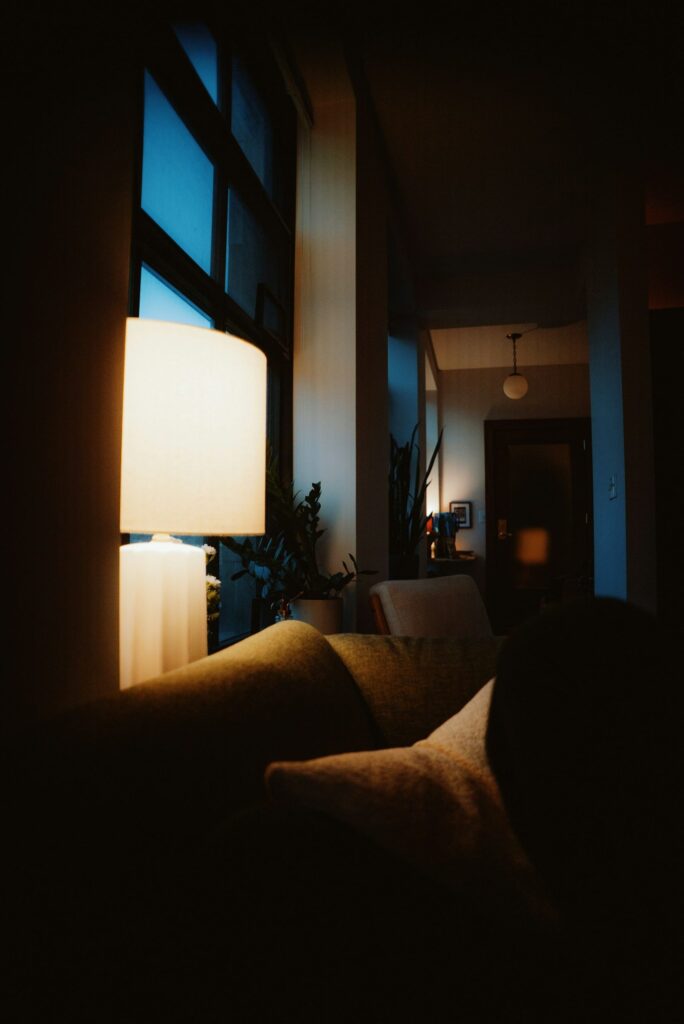
Good evening light is selective. It gives someone enough light to read, to pour a drink, or to find the edge of a chair. It does not try to eliminate every shadow. A lamp placed at seating height makes a corner legible without demanding that the entire ceiling participate.
The common failure is a single central fixture doing all the work. It brightens the room, certainly, but it removes the difference between the place where you sit and the place where you walk through. Add one lamp before you add a brighter overhead bulb. The room will feel more intentional with less total light.
Choose shades that soften the source
A visible bare bulb can be useful in a workshop. In a living room, it asks to be looked at. Fabric, paper, or lightly opaque shades do the quieter work of spreading the source. The lamp becomes a glow rather than an event.
This is also why lamp scale matters. A small lamp on a large console can feel like an afterthought; an oversized shade on a tiny table can become a prop. Look for a pool of light that reaches the nearby surface and a little beyond it, without announcing where the bulb is hiding.
Put the lamp where the conversation already is
A lamp does not need its own corner to justify itself. The most useful position is often just behind or beside the place people naturally choose to sit. Let it overlap the edge of a chair, sofa, or console in the visual field. That small connection makes the light feel attached to the room’s purpose rather than parked around the perimeter.
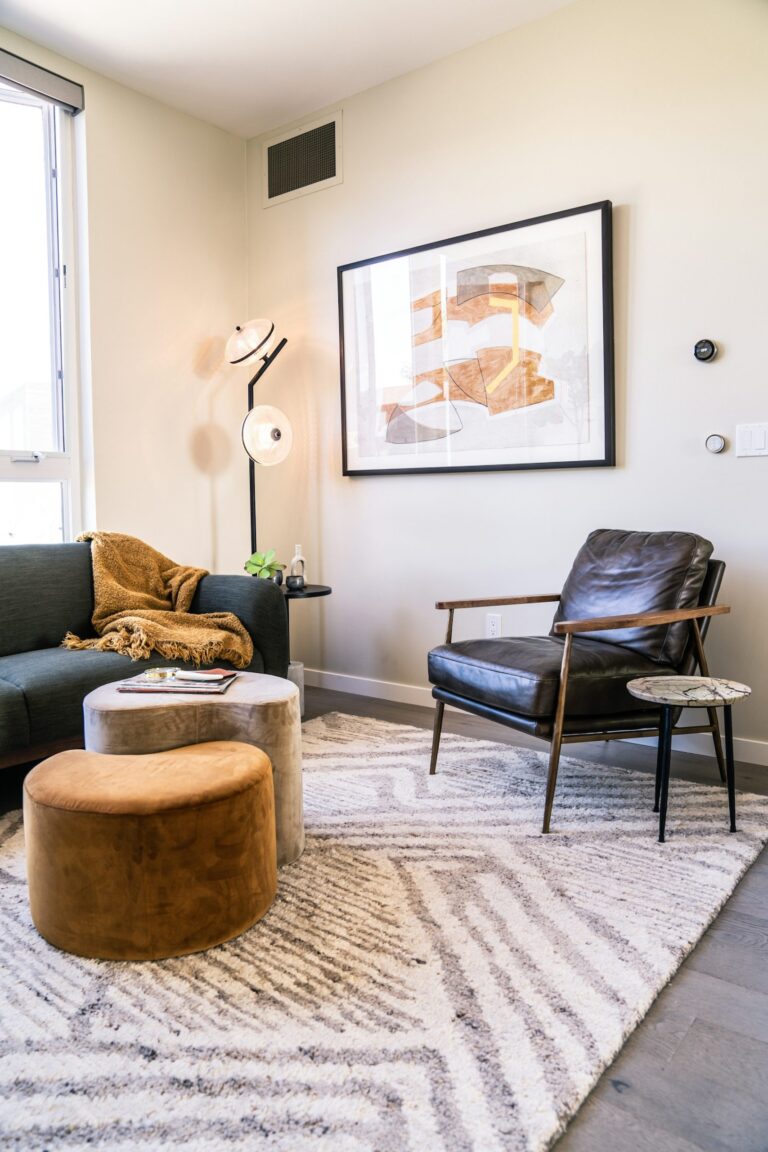
Floor lamps are especially good at this because they can be moved before they are committed. Try one behind the arm of the sofa for a night, then beside the reading chair, then near the window. The right position is the one that makes a person look settled when they are sitting there, not the one that makes an empty room look most symmetrical.
Let curtains help after dark
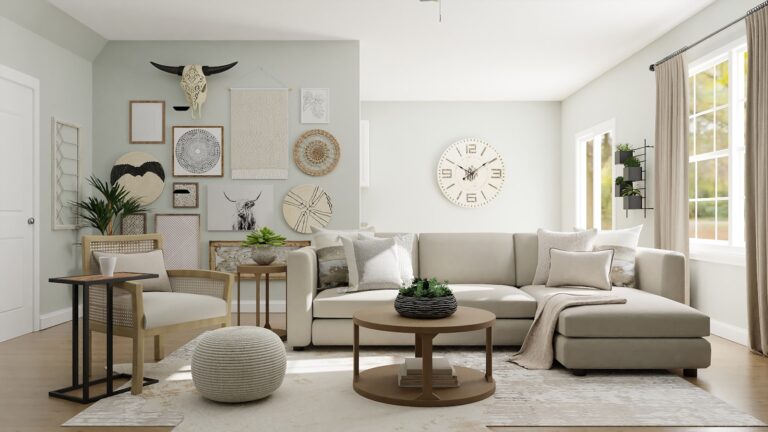
Curtains are often treated as daytime tools: privacy, glare, insulation. At night they do something else. They remove the black rectangle of a window and give lamp light a softer boundary to meet. Full-length panels in a warm neutral do more for the feeling of an evening room than another decorative cushion.
Close them before the room goes fully dark. That is a small but useful ritual: the window stops competing with the interior, and the lamp can do its quieter work. In rooms with close neighbours or a street-facing window, the benefit is practical too. You get privacy without needing to make the room feel sealed off during the day.
Use texture where the light lands
The last part of the test is material. Light needs a surface with enough texture to catch it. A waffle throw, woven basket, matte wood table, or linen curtain makes a modest lamp look richer because the room gives the light somewhere to settle. Shiny surfaces bounce it around; textured ones keep it close.
Keep those textures in the part of the room that you actually see from a seat. A single throw folded over the arm of the sofa and a woven basket near the floor are enough to change the way a lamp reads. There is no need to distribute texture evenly across every surface. The room should have a few soft places to rest, not a theme applied to everything.
Try the test before buying anything: switch off the overhead fixture, turn on the nearest lamp, and sit down. If the room feels like it has no place to land, add one source at seating height. If it feels harsh, change the shade or reduce the bulb. If it feels flat, give the light a textured material to meet.
Use warm light with a reason
For most evening rooms, a warm-white bulb is the useful default. It lets woods, linen, and skin keep their depth instead of turning grey under a cooler source. But colour temperature is not a substitute for placement. A very warm bulb in a ceiling fixture can still make a room feel like it is being inspected. Put the softer light lower first, then decide whether the overhead fixture needs to be on at all.
It also helps to separate arrival light from staying light. The first can be practical: enough to find the switch, set down a bag, and see the way through. The second is the lamp near the chair, sofa, or console. When both jobs come from one bright source, the room tends to feel either too dark to use or too bright to relax in.
The after-dark edit
The after-dark board uses only the pieces this article calls for: two lower light sources, full-length curtains, a textured throw, and a natural-fibre rug that gives the light somewhere to settle.
See the complete After-Dark Living Room edit →
The goal is not a dim room. It is a room that knows where the evening happens.
Photography by Evan Wise via Unsplash, used under the free Unsplash License.