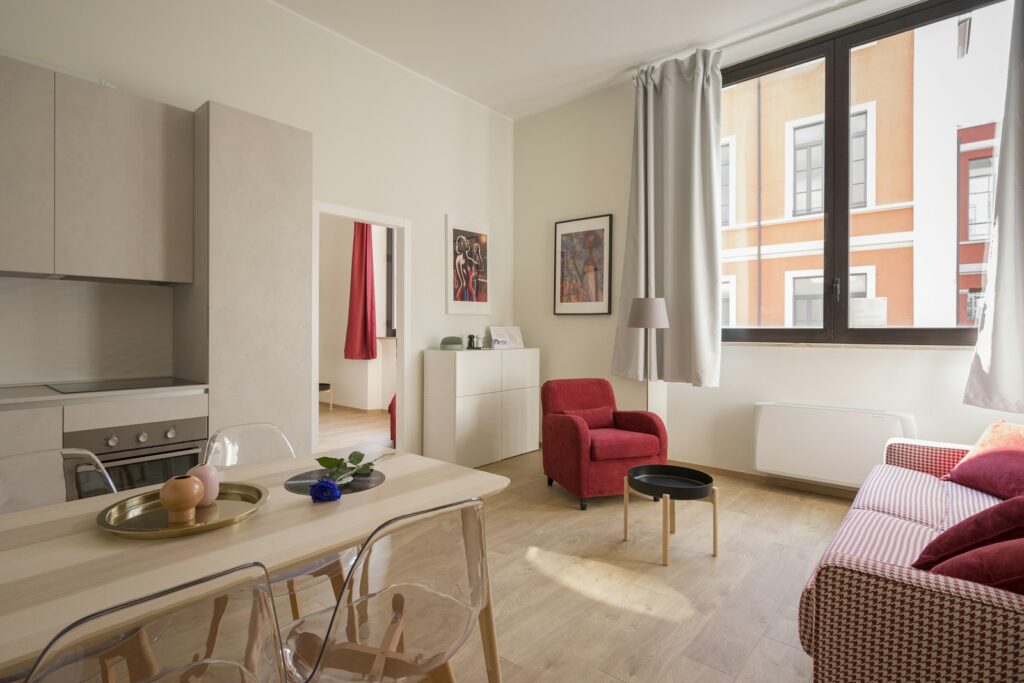
The mistake in most studios is treating the whole floor as one room and pushing everything against the walls. What makes a small space feel bigger is the opposite: clear zones with legible edges, so that crossing from “kitchen” to “living room” registers as movement between places — even when it’s four steps. Four kinds of edge do most of the work in the studios that pull this off (a curtain on a ceiling track is the honorable fifth, if your lease allows the hardware).
Edge one: the rug line
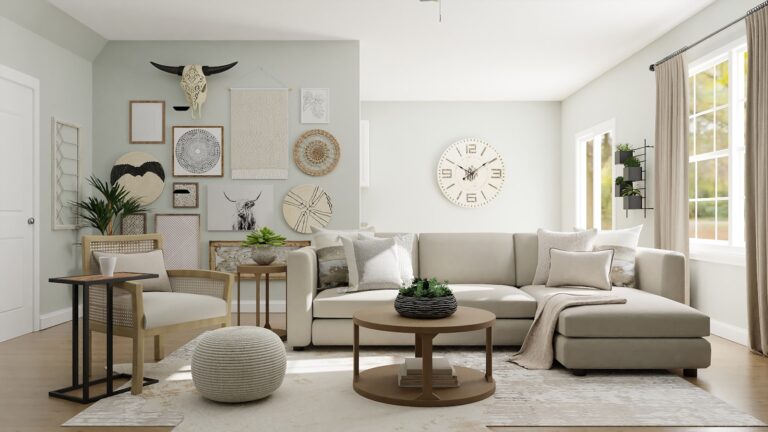
A rug is a room outline you can buy. The seating zone is wherever the rug is, and — this is the part people skip — the rug’s edge should run parallel to something: the sofa, the window wall, the counter. A rug set at a casual angle in a small space reads as mess, not ease. One rug per zone, and bare floor between zones as the “hallway.”
Edge two: the back of the sofa
Float the sofa with its back to the sleeping area and it becomes a wall that also seats three. A low bookcase or console along the sofa’s back strengthens the edge and adds the storage a studio never has enough of. Keep the divider at or below shoulder-height-when-seated (roughly 110cm) — light must travel over it or the whole plan darkens.
Edge three: light pools
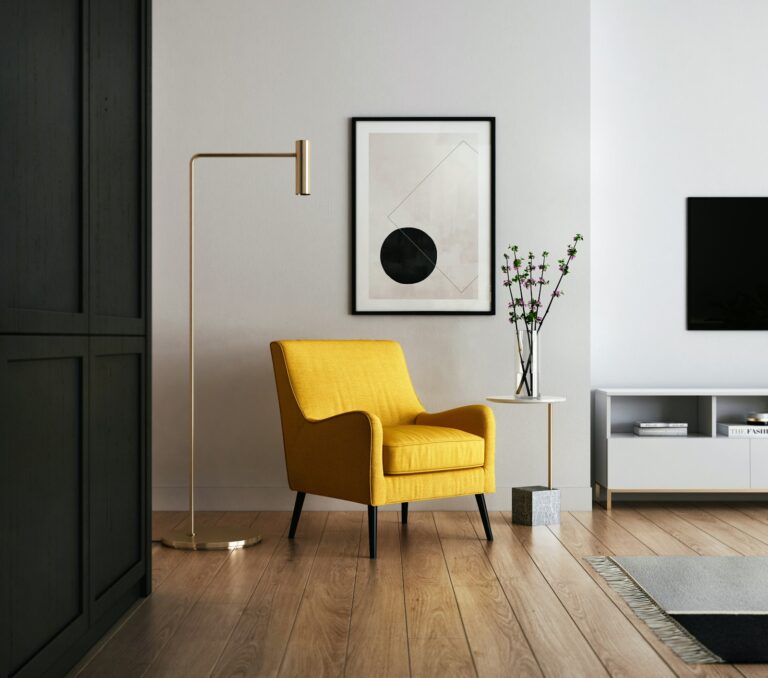
Give each zone its own light source and switch them separately (the studio as a whole can hold two or three pools burning at once — but each zone owns one): a floor lamp by the reading chair, a small table lamp at the bedside, the kitchen’s own light. In the evening, whichever pool is on defines the room you are “in,” and the rest of the studio politely disappears. This is the cheapest zoning tool that exists — three warm bulbs and two smart plugs.
Edge four: one material change
The sleeping zone can shift softer: a different curtain fabric, a wall color one shade deeper, textiles where the living zone has wood. Keep it to one change per boundary. Small spaces amplify everything, and a studio with four flooring materials and three accent walls stops being zoned and starts being loud.
What not to buy
Skip the freestanding folding screen (it eats 60cm of floor to block light and wobble) and skip the “small-space furniture” category almost entirely — many pieces sized for dollhouses just make ceilings look taller and rooms emptier. A full-size sofa in a well-zoned studio looks generous. Five miniature chairs look like a waiting room for children.
Photography via Unsplash, used under the free Unsplash License.